If you’ve been in a collision, even a seemingly minor one, your vehicle’s Advanced Driver Assistance Systems probably need recalibration. These safety systems rely on millimeter-level accuracy, and any impact that affects cameras, sensors, or radar can throw them off without triggering a warning light.
Here’s when calibration is mandatory, what happens during the process, and why skipping it puts you at risk.
When ADAS Calibration Is Required After a Collision
Your vehicle needs ADAS recalibration any time collision repairs affect the position or alignment of safety system components. This isn’t optional — it’s part of restoring your vehicle to factory specifications.
| Repair Type | Calibration Required? | Reason |
|---|---|---|
| Front bumper replacement | Yes | Radar sensors embedded in bumper cover |
| Windshield replacement | Yes | Forward-facing camera mounting position changes |
| Frame straightening | Yes | Structural alignment affects sensor angles |
| Hood or fender replacement | Often | Depends on sensor locations and vehicle model |
| Rear bumper replacement | Often | Backup cameras and parking sensors affected |
| Door mirror replacement | Sometimes | Blind spot monitors housed in mirrors |
Manufacturers specify calibration requirements in repair procedures. If your insurance adjuster or body shop doesn’t mention calibration after structural work, that’s a red flag.
Which ADAS Systems Need Calibration
Modern vehicles have multiple safety systems working together. A single collision can affect several at once.
Camera-Based Systems
Forward collision warning, lane departure warning, automatic emergency braking, and traffic sign recognition all depend on windshield-mounted or grille-mounted cameras. If the camera moves even a few millimeters, the system sees the road incorrectly.
Radar and Lidar Sensors
Adaptive cruise control and blind spot monitoring use radar behind bumper covers. These sensors must aim at precise angles. After bumper replacement or frame straightening, they’re guaranteed to be out of alignment even if they still power on.
Ultrasonic Sensors
Parking assist systems use ultrasonic sensors in bumpers. These need recalibration after any bumper work to detect objects at the correct distances.
Warning Signs Your ADAS Needs Calibration
Sometimes your vehicle will tell you directly. Other times, the problem is silent until the system fails when you need it.
Dashboard warning lights or messages about camera obstruction, adaptive cruise control unavailable, or lane assist errors are obvious signs. If you see these after a collision repair calibration was likely skipped.
More concerning are invisible failures. Your forward collision warning might activate late or not at all. Lane keeping assist might pull toward the center line instead of away from it. These failures happen because sensors are aimed incorrectly but haven’t triggered a fault code yet.
What Happens During Professional ADAS Calibration
Proper calibration requires factory-specific equipment and procedures. This isn’t something you can eyeball or skip.
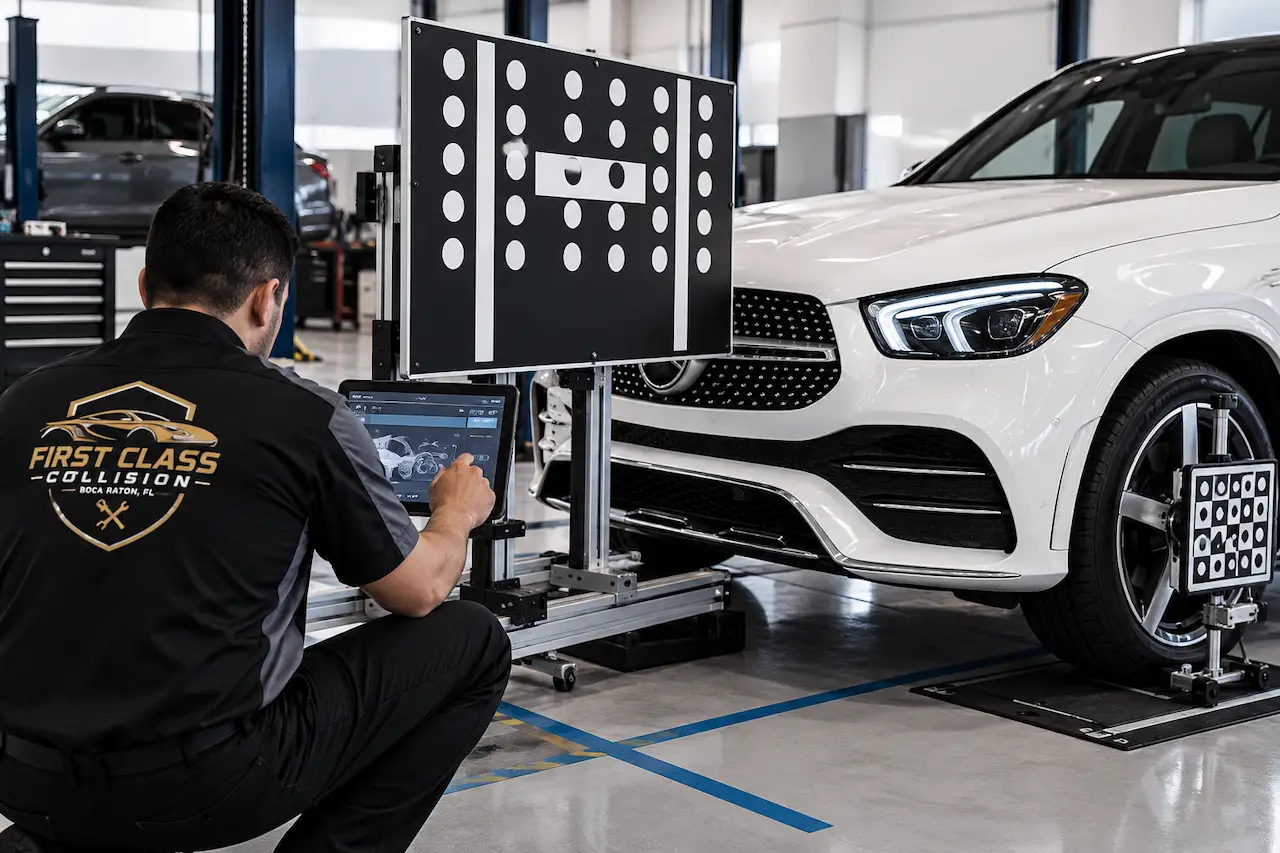
Static calibration happens in the shop using positioning targets and laser alignment tools. The vehicle sits on a level surface while we position specific patterns at exact distances and angles from cameras and sensors. The system then learns its new baseline.
Dynamic calibration requires driving the vehicle at specific speeds on marked roadways while the system’s computer relearns lane markings and distance measurements. Some vehicles need both methods.
The process typically takes one to three hours depending on how many systems need attention. At First Class Collision we follow OEM calibration procedures exactly.
Why Accurate Calibration Matters
Insurance may deny a claim if a future collision involves ADAS failure and records show calibration was never performed after previous repairs. More importantly, these systems are designed to prevent accidents. A lane departure warning that activates two seconds late defeats the entire purpose.
Luxury vehicles often have the most complex ADAS suites. Mercedes, BMW, Audi, Tesla, and other premium brands integrate multiple systems that all reference each other. Calibrating just one camera without addressing the full network creates cascading errors.
Frequently Asked Questions
Does insurance cover ADAS calibration after a collision?
Yes, if calibration is part of the manufacturer’s required repair procedures. It’s included in the collision repair estimate, not a separate optional service. Reputable shops include calibration in the initial quote.
How do I know if my car has ADAS that needs calibration?
If your vehicle has adaptive cruise control, lane keeping assist, automatic emergency braking, blind spot monitoring, or a forward-facing camera behind the rearview mirror, it has ADAS. Check your owner’s manual or ask during your repair estimate.
Can I calibrate ADAS myself?
No. Calibration requires manufacturer-specific diagnostic software, positioning targets, and procedures. You need a certified collision center or dealership.
What happens if I skip calibration after a collision?
Safety systems may fail when you need them, activate incorrectly, or cause unexpected braking or steering. You may also face insurance claim denial or failed vehicle inspections depending on your state.
How long does ADAS calibration take?
Static calibration takes one to two hours. Dynamic calibration adds another hour of road testing. Complex luxury vehicles with multiple systems can take three hours total.
Ready to Schedule ADAS Calibration in Boca Raton?
If your vehicle was in a collision and ADAS calibration wasn’t part of the repair, or if you’re seeing warning lights and system errors, we’ll inspect your safety systems and perform manufacturer-specified calibration using factory-approved equipment. First Class Collision handles complete collision repairs including all required ADAS work.
Call (561) 417-2333 or visit First Class Collision to book your Boca Raton appointment.