
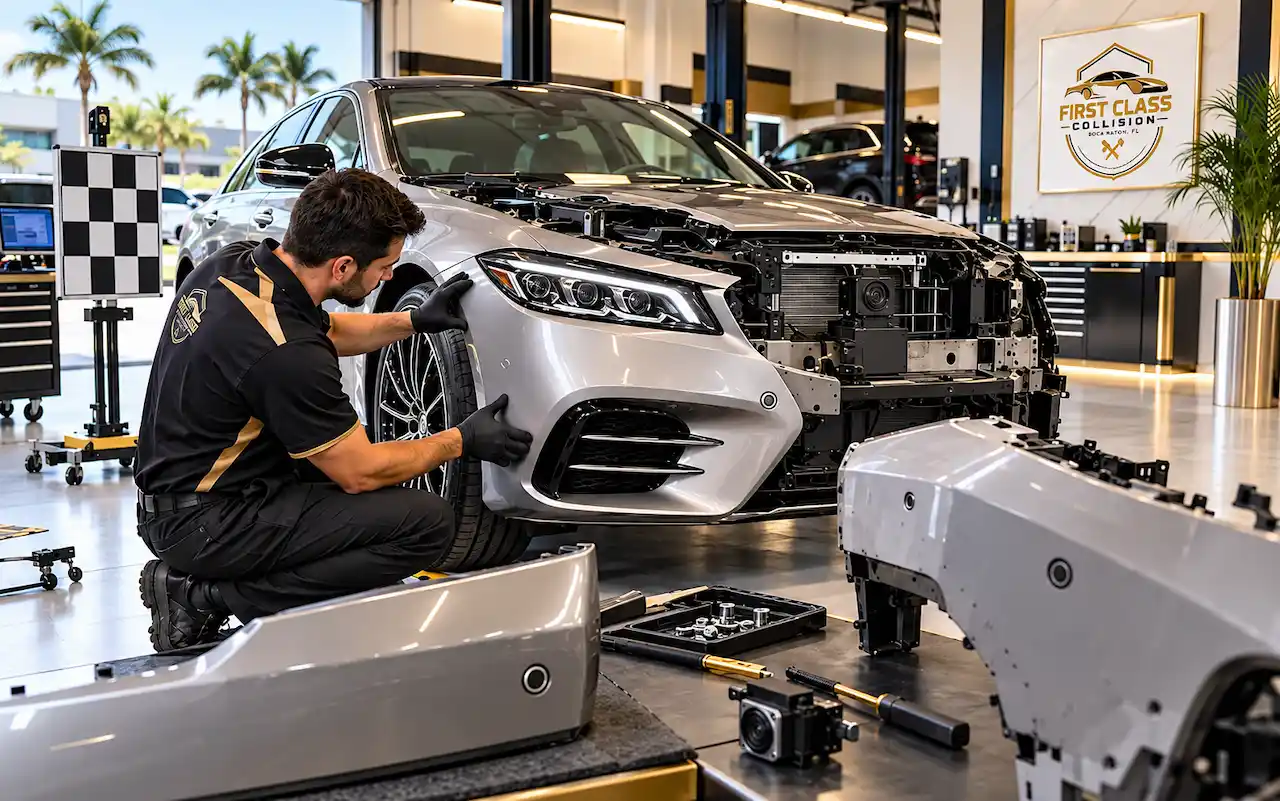
After a collision, your insurance adjuster or repair shop will mention “OEM parts” or “aftermarket parts.” The difference affects how your car looks, how it drives, what your insurance covers, and what your vehicle is worth at resale. If you own a luxury vehicle or a late-model car with advanced safety systems, the parts choice matters even more.
Here’s what each option actually means and when each one makes sense for your repair.
OEM vs Aftermarket Parts: The Core Difference
| Part Type | What It Is | Fit & Finish | Warranty | Typical Cost |
| OEM (Original Equipment Manufacturer) | Made by or for the vehicle manufacturer. Same part that came on your car from the factory. | Exact match. Designed for your specific make, model, and year. | Manufacturer warranty. Maintains factory repair standards. | Higher — typically 20-60% more than aftermarket |
| Aftermarket | Made by third-party companies. Not affiliated with your vehicle manufacturer. | Varies widely by brand. Some fit well, others require adjustment or have visible gaps. | Aftermarket company warranty (varies). May not meet factory standards. | Lower — budget-friendly option for older or non-luxury vehicles |
When OEM Parts Are Worth the Extra Cost
I recommend OEM parts in these situations, and we prioritize them at First Class Collision when the vehicle and repair justify it:
Luxury and High-End Vehicles
Brands like Mercedes, BMW, Audi, Porsche, Tesla, and Lexus are engineered with tight tolerances. Aftermarket bumpers, fenders, and hoods often don’t align correctly, leaving visible gaps or panel mismatches that hurt resale value. If you’re driving a $70,000+ vehicle, a $200 savings on an aftermarket fender isn’t worth the finish issues.
Structural or Safety-Critical Parts
Frame rails, crumple zones, airbag housings, and steering components should be OEM. These parts are crash-tested as part of the original design. Aftermarket versions may use different metal grades or thicknesses, which can affect how your car performs in a second collision.
Vehicles with Advanced Driver Assistance Systems (ADAS)
If your vehicle has forward collision warning, lane-keeping assist, adaptive cruise control, or parking sensors, the parts that house those cameras and radar units need to mount exactly where the factory intended. An aftermarket bumper or grille that shifts a sensor by even a few millimeters can throw off calibration. We handle ADAS calibration after repairs, but calibration can’t fix a part that doesn’t position the sensor correctly.
Leased Vehicles
Most lease agreements require OEM parts for repairs. Using aftermarket parts can trigger penalties at lease return if the dealership inspects and finds non-factory components.
When Aftermarket Parts Can Be a Smart Choice
Aftermarket parts aren’t always a compromise. For certain vehicles and situations, they’re a perfectly reasonable option.
- Older vehicles with lower market value. If you’re repairing a 2012 sedan worth $6,000, spending an extra $800 on OEM parts doesn’t make financial sense. A quality aftermarket bumper will look fine and function properly.
- Non-visible or non-structural components. Inner fender liners, underbody shields, and some brackets don’t affect appearance or safety. Aftermarket versions often work just as well.
- Insurance policy limits. Some policies only cover aftermarket parts unless you’ve purchased OEM endorsement coverage. If your policy specifies aftermarket and you want OEM, you’ll pay the difference out of pocket.
We don’t automatically push OEM on every repair. If the aftermarket makes sense for your situation, we’ll tell you. If it doesn’t, we’ll explain why before you approve the estimate.
What About “OEM Certified” Aftermarket Parts?
Some aftermarket manufacturers claim their parts are “certified” or “OEM equivalent.” These labels aren’t standardized. A part can be certified by an independent testing company but still not meet the vehicle manufacturer’s specifications.
The only true OEM part comes from the manufacturer or an authorized supplier with the manufacturer’s stamp. If a part is described as “OEM quality” or “OEM fit,” it’s still aftermarket.
How Insurance Companies Handle OEM vs Aftermarket
Most insurance policies default to aftermarket parts unless your policy includes an OEM parts endorsement. Even without that endorsement, insurers will usually cover OEM parts for:
- Vehicles still under factory warranty
- Leased vehicles
- Newer vehicles (typically less than 2-3 years old)
If your policy allows aftermarket but you want OEM, you’ll pay the price difference. We handle insurance estimates directly and can walk you through what your policy covers before the repair starts.
Why We Prioritize OEM Parts for Most Repairs
At First Class Collision, we’re a factory-trained shop that specializes in luxury vehicle repairs. Our technicians follow manufacturer repair procedures, which almost always call for OEM parts. We use OEM because:
- Fit and finish are guaranteed to match factory standards
- Paint adhesion and primer coatings are consistent
- We can maintain the lifetime warranty we offer on repairs
- Resale value and vehicle integrity stay intact
That said, we’re not going to install a $1,200 OEM fender on a 15-year-old car if a $400 aftermarket part does the job. We discuss options with you before the work is approved, and the final decision is always yours.
Frequently Asked Questions
Will aftermarket parts void my car’s warranty?
Not automatically, but if an aftermarket part causes a related failure, the manufacturer can deny coverage for that specific repair. For example, an aftermarket radiator support that cracks and damages the radiator might not be covered under your powertrain warranty. OEM parts keep your factory warranty intact.
Can I tell the difference between OEM and aftermarket once the repair is done?
On a luxury vehicle, yes — you’ll often see panel gaps, paint texture differences, or slight misalignments. On older or economy vehicles, a good aftermarket part installed by a skilled shop can be nearly indistinguishable from OEM.
Does my insurance have to pay for OEM parts?
Only if your policy includes OEM parts coverage or if the vehicle meets the insurer’s criteria (leased, under warranty, very new). Otherwise, they’ll estimate with the aftermarket. You can request OEM and pay the difference yourself.
Are all aftermarket parts the same quality?
No. Aftermarket quality varies widely. Some manufacturers produce parts that fit and function well. Others produce cheap versions with poor materials or incorrect dimensions. A reputable shop will only source from known aftermarket suppliers.